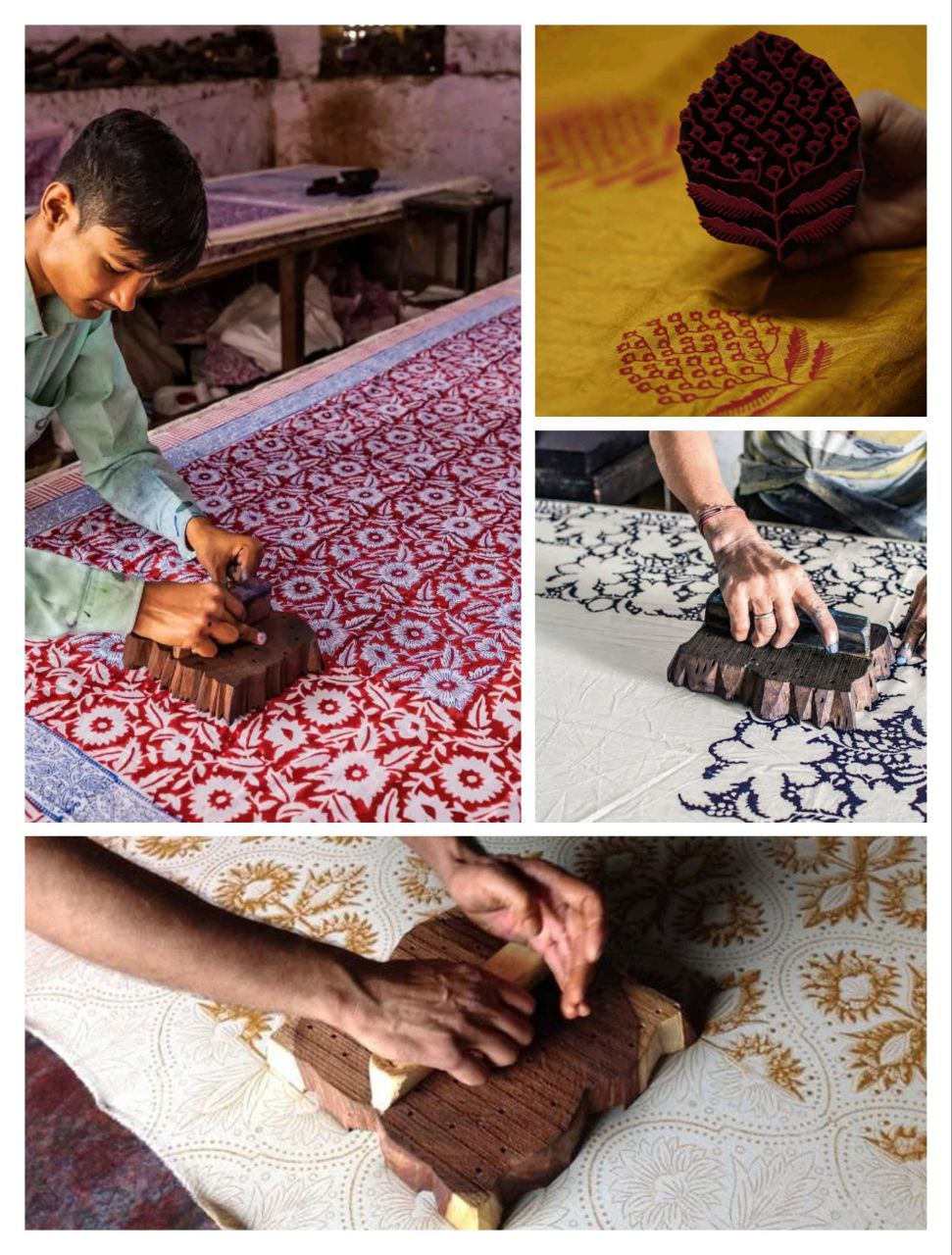
Woodblock printing on textiles is the process of printing patterns on fabrics, typically linen, cotton, or silk, by means of carved wooden blocks. The 'woodblock' is known as chhapa in South Asian countries like India, Burma, Bangladesh, Nepal and Pakistan.There are many different communities in various parts of the world associated with the art of woodblock printing. For some, it is considered a traditional occupation. Communities or classes such as Chhipi, Chhimba, Chhapa, Chhapola in India, craftsmen and merchant classes in China, and Ryōmin (良民) and Senmin (賤民) in Japan are involved in woodblock printing.
Printing patterns on textile is closely related to other methods of fabric manipulation, such as by painting, dyeing, and weaving. Woodblock printing on textiles can be traced back to the ancient use of stone blocks and wood, carved to make impressions on various materials. Ancient civilizations such as those in China, Egypt, and Assyria likely used printing on textiles alongside other materials from a very early period. For example, there is direct evidence that people in South Asia, including some from Punjab and Mumbai, extensively used printing for textile decoration from early on. Beginning in the 16th century, European, particularly Dutch merchants, bought printed and painted calico for trade. Despite the great skill displayed by the Chinese in ornamental weaving and other branches of textile art, there seems to be no direct evidence of their using printing for textile decoration as extensively as in India. In the nineteenth century, woodblock printing in Europe was developed and modified through the use of machinery, stereotypes, and engraved metal plates.