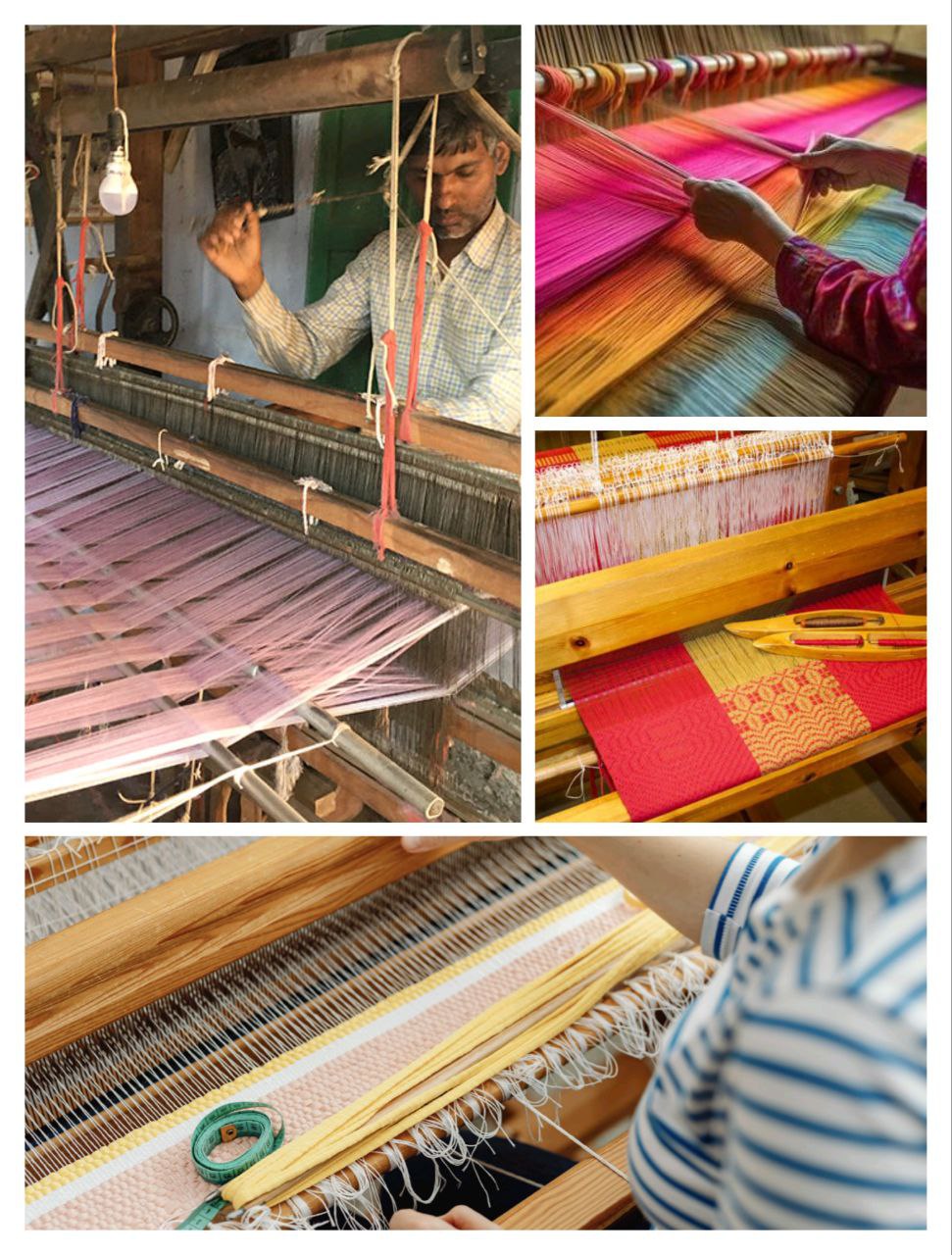
A handloom sari is often woven on a shuttle-pit loom made from ropes, wooden beams and poles.The shuttle is thrown from side-to-side by the weaver. Other weavers use a fly-shuttle loom which can produce different types of patterns. The saris can vary in size and quality.Handloom sari weaving is generally a family business and is one of India's cottage industries.The handloom saris are made from silk or cotton threads. The handloom weaving process requires several stages in order to produce the final product. Traditionally the processes of dyeing (during the yarn, fabric, or garment stage), warping, sizing, attaching the warp, weft winding and weaving were done by weavers and local specialists around weaving villages.However, currently most of the activities are outsourced.A handloom sari is often woven on a shuttle-pit loom made from ropes, wooden beams and poles.The shuttle is thrown from side-to-side by the weaver. Other weavers use a fly-shuttle loom which can produce different types of patterns. The saris can vary in size and quality. Handloom sari weaving is generally a family business and is one of India's cottage industries.The handloom saris are made from silk or cotton threads. The handloom weaving process requires several stages in order to produce the final product. Traditionally the processes of dyeing (during the yarn, fabric, or garment stage), warping, sizing, attaching the warp, weft winding and weaving were done by weavers and local specialists around weaving villages.However, currently most of the activities are outsourced.
The handloom sector plays a vital role in India's economy. It is responsible for nearly 22% of the cloth produced in the country. The handloom sector is the second largest economic activity after agriculture, employing nearly 30 lakh (three hundred thousand) weavers and 4.33 million people in all, according to the Handloom Census of 2009–2010. In the 2010 census, 4.4 million families were engaged in hand weaving. In December 2011, the handloom industry wove 6.9 billion square metres (74.3 billion square feet) of cloth.The economic policy in India aims to advance the handloom industry from the pre-independence period. The Textile Policy 1985 emphasized the promotion of handloom garments. Andhra Pradesh is said to be the home of 359,212 weaver families who work in primary cooperative handloom societies. Primary Handloom Weavers Cooperatives (PHWCS) includes weavers within certain specific geographical limits and provides production work to the members. The cooperatives also ensure that the weavers receive fair wages and conduct various welfare measures.